EV Flow: Rebuilding EV Cargo's Supply Chain Platform
A ground-up redesign of LIMA, a 50+ tool legacy system used across every stage of the supply chain
platform
Web application
My Role
Sole designer
Timeline
Jun 2022 - Dec 2025
Overview
EV Flow is EV Cargo's next-generation platform for managing the end-to-end supply chain, from purchase order creation through shipment, customs clearance, and final delivery. Built as a modern, multi-tenant platform, it serves multiple user groups including retailers, suppliers and warehouse teams, each with role-specific tools and workflows.
The project was a ground-up redesign of LIMA, EV Cargo's legacy system, an enterprise application comprising more than 50 specialised tools. It had accumulated years of complexity with no clear path to simplification. Many areas required years of domain knowledge just to navigate.
My Role
As the sole UI/UX designer, I was responsible for translating business and product requirements into design, from wireframing and prototyping through to final UI. I led the complete overhaul: replacing dense, unintuitive workflows with a modern interface that delivers the same functional depth and beyond, without the friction.
I worked closely with the product development team and product delivery manager, iterating on designs based on feedback from users and the team.
Phase 1: UX Research and Understanding the Problem
In this phase, I organised workshops and worked closely with Product Development Team and SMEs (internal users) to understand users’ needs, work flows and their pain points in LIMA.
LIMA's most complained pain points:
Confusing user flows
Overwhelming data
Cluttered interface
Inconsistent layouts
Notes taken from the workshops

Dive Deeper
LIMA comprises 50+ tools spanning every stage of the supply chain. This case study focuses on Shipment Authority, a tool for retailer teams to update shipment status.
Data is structured hierarchically: users input or select values at the header level, with granular detail surfaced in nested parent/child tables below.
The core need was simple: users must be able to update values at every level, quickly and without friction.
/ Screenshots from lima with annotations /

Phase 2: Exploring Solutions with an Iterative Approach
In this phase, I explored a range of ideas and potential solutions, working closely with the product development team and SMEs to guide my ideation process and narrow down directions. The final design went through multiple rounds of review, evolving considerably along the way.
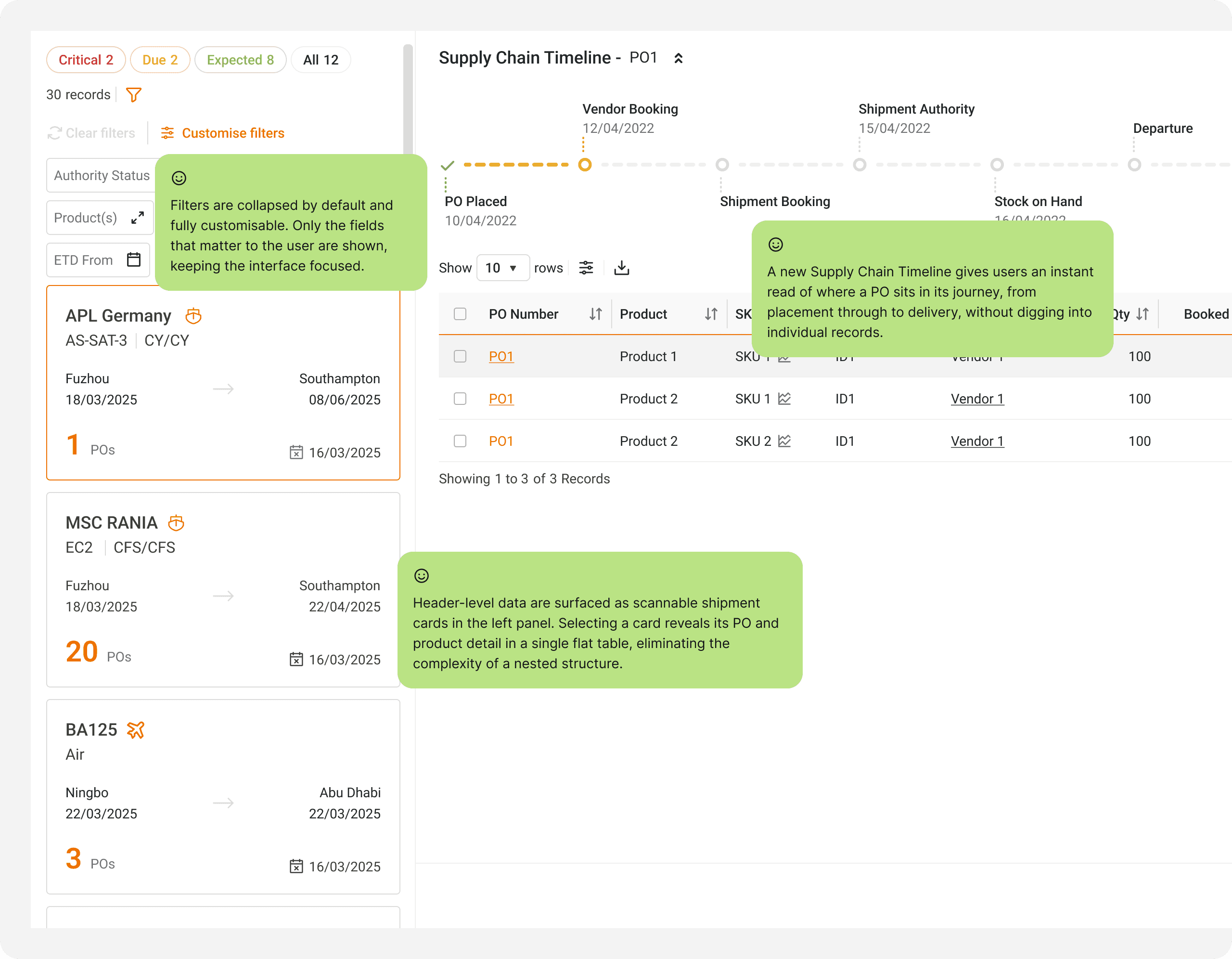


Earlier Iterations
The design went through several rounds before landing on the final version. Here are some of the iterations that didn't make the cut.
/ The very first version /

/ Version 2.0 /

Phase 3: UI Design, Prototype and Component Creation
In this phase, I created high-fidelity designs and interactive prototypes, working closely with the product manager to map out every use case, scenario, and edge case. Each screen was designed pixel-perfect, and I identified reusable patterns along the way to expand and refine the design system for consistency and efficiency.

Phase 4: Delivering to Development
With designs finalised, I partnered closely with engineering to bring EV Flow to life. This involved preparing detailed handoff documentation. I stayed closely involved through implementation, reviewing builds against the designs, clarifying edge cases as they surfaced, and making adjustments where technical constraints required design trade-offs.
Summary
The redesign reimagines how SCM data is surfaced and acted on — replacing cluttered tables and buried actions with a clear visual hierarchy, streamlined workflows, and an interface users can navigate without a manual.